
Happy Valentine’s Day! This was supposed to be a day for chocolate, flowers, going out for dinner with a sweetheart, etc.
But instead, Mother Nature threw a nasty surprise that kept us all away from work and stuck indoors for most of the day. The Washington, D.C. area has been under a winter storm condition where 2-4 inches of ice and sleet is covering everything outdoors. In the early afternoon, I managed to go outside and spent couple of hours clearing the cars and walkways of thick ice. That was no walk in the park and it required heavy physical exertion. I was so tired afterwards (price to be paid for running so little lately) that I fell asleep sitting on a chair in front of the computer. My body felt like I did a hard 60-90 minute run.
Speaking of a run, I wonder how many people braved the severe weather to go out for a run today. I am sure there were some hard core running nuts- I mean enthusiasts- that hit the icy pavements this morning just as they do everyday without fail. These enthusiasts put to shame the US Postal service who claims that “neither snow, nor rain, nor heat…” will ever stop it from delivering mail. If you are wondering, yes, I did see the mailman deliver today!
Anyway, these committed runners are known as “streak runners.” Not to be mistaken with lunatics who enjoy sprinting across a crowd in the nude, these streakers are known for not missing a day of run for decades, even on days such as the one we had today. These people run through injury, bad weather, surgery, death of a loved one, or anything else you can think of.
Last March, as a way to motivate myself, I decided to see how many consecutive days that I could run. I managed to run everyday for forty five days but then I missed a day. And of course, once you miss a day you will soon miss another, which is perhaps why these people do anything to keep their streak alive.
Still, I can’t imagine how anyone could manage to run every single day for twenty years or more. For that matter, I can’t even imagine running everyday for a year, which is the minimum requirement to become an official streaker. Can you think of anything (not life sustaining) that you have done everyday for a year more? Perhaps praying or reading your Bible or driving a car or even surfing the internet? I don’t think many can answer this question in the affirmative.
So why do streakers do what they do? A possible explanation could be that they are addicted to running. And yes, there is such a thing as “running addiction.” You may be asking yourself whether running addiction is a good thing or not. An argument can be made that no addiction is a good thing. However, I would counter argue that most people already have a “no-exercise addiction” and I am convinced that a running addiction would beat that any day.
So I need your help to become an addict. I want to know if anyone is interested in attempting to become an official streaker. We will start slow and maybe try just one week and then perhaps a one month streak initially. For ease of keeping track, we can start on March 1. Of course, all the risk (and benefit) is exclusively yours and yours only. Therefore you will need to make sure you are medically cleared by your doctor before making your attempt on becoming a streaker.
Finally, I must say that it sure is strange to feel like a “drug” pusher, but it is a price I am willing to pay to make an “addict” out of myself.
Wednesday, February 14, 2007


Friday, February 09, 2007
Haile's Record...Gone!
On January 15, 2006, Haile Gebrselassie added one more world record to his resume when he ran the Rock and Roll Arizona Half-Marathon in 58:55 in Phoenix. It was a great beginning to a year that saw Haile win two marathons- Berlin and Fukuoka- register the fastest marathon of 2006 and set the Ethiopian national record for the marathon. The half-marathon record in Arizona was indication of the great form Haile had and all the achievements to come during the year.
That half-marathon record was broken today, by a mere two seconds, when Sammy Wanjiru ran 58:53 to win the Ras Al Khaima International Half Marathon in the United Arab Emirates today. Birhane Adere won the women's race in 1:10:58 as Ethiopian women dominated the race by sweeping the top four places. Finishing behind Birhane were Teyiba Erkesso, Bizunesh Bekele, and Dire Tune taking up second through fourth place.
Haile was informed that his record was broken shortly after the race. He replied only as Haile "The Emperor" would reply. He promised a quick response "as soon as I can find another half-marathon."
In other news, Kennenisa Bekele's much anticipated 1500M indoor race in Valencia, Spain has been scratched due to a minor injury he suffered in training. We will wait to see if he goes ahead with his plan to race the 2000M next week in Birmingham, England where Tirunesh Dibaba will also attempt to break the 3000M world indoor record set by Meseret Defar just last weekend.
That half-marathon record was broken today, by a mere two seconds, when Sammy Wanjiru ran 58:53 to win the Ras Al Khaima International Half Marathon in the United Arab Emirates today. Birhane Adere won the women's race in 1:10:58 as Ethiopian women dominated the race by sweeping the top four places. Finishing behind Birhane were Teyiba Erkesso, Bizunesh Bekele, and Dire Tune taking up second through fourth place.
Haile was informed that his record was broken shortly after the race. He replied only as Haile "The Emperor" would reply. He promised a quick response "as soon as I can find another half-marathon."
In other news, Kennenisa Bekele's much anticipated 1500M indoor race in Valencia, Spain has been scratched due to a minor injury he suffered in training. We will wait to see if he goes ahead with his plan to race the 2000M next week in Birmingham, England where Tirunesh Dibaba will also attempt to break the 3000M world indoor record set by Meseret Defar just last weekend.
Wednesday, February 07, 2007
A Day With Tirunesh Dibaba
Spend A Day With Tirunesh Dibaba
By Toby Tanser, Runner’s World Correspondent
Standing on Seventh Avenue in designer jeans and a white turtleneck in 25-degrees Fahrenheit the only thing that set this small (155cm) Ethiopian young lady aside from the other New Yorkers is the fact that she is not wearing a jacket. In fact, the group of girls standing next to her, oblivious to the Ethiopian's rock star status in the running world, look equally as thin and as athletic. Tirunesh Dibaba is what Michael Jordan was to men's basketball, and more. She has won the world cross-country championships three times, was the first person ever to win a 5000/10,000m double at the World Championships, and has broken world records to boot. The other women on the circuit fear 21-year-old "Tiru" like no other. Since her breakthrough in 2003 when the baby-faced assassin demolished all other juniors and then, a day later, took seventh place at the World Seniors Cross Country, she has been the lady to beat. Of course there have been a few pimples on the way, like "only" winning a bronze medal in the 2004 Olympics, a defeat that pains her to this day, but all in all, the woman who runs for the Mizuno Club on the international circuit has been an out and out winner.
Although this was Dibaba's first trip to the Millrose Games, for the inaugural New York Road Runners 3000 meters, she has graced the city in 2005 with her fast legs. Then, on a hot humid afternoon outdoors at Randall's Island, she ran 14:32:42 - the fastest women's 5000 ever run on American soil. Interestingly, earlier in that year she had run 14:32:93 to set an indoor record at the Reebok Boston Indoor Games - a record she broke on Saturday past with 14:27:42.
Rolling back the clock: A young Tiru to attend loved Bekoji Primary School, her favorite subject being the studies of Amharic, her mother tongue. Thus she was disappointed, when traveling to Addis Ababa at age 14 to continue her studying, that she missed the class registration by six days. She went to stay with her sister, Ejegayehu who is also a world class distance runner, and decided to start training. The two still live together in Addis, but the living conditions have been upgraded now. Bekelu Dibaba, a cousin, enrolled her in the Prison's Sports Club after Tiru proved herself finishing fifth in a trial race round a horse track. The systematic training soon paid off. Within a year she had ran at the World Junior Cross Country Championships, placing fifth. No eyebrows were raised; she was an African, wasn't she? Even back home in the village of Chefe, the result did not impress many. The cousin of Dibaba, on the father's side, and a neighbor at the town of Bekoji, had set high family standards winning the seniors, and a couple of Olympic gold medals. Derartu Tulu is a legend in Ethiopia; the great Kenenisa Bekele named her, not Gebrselassie, as being his inspiration. Imagine what heights Tiru set for herself growing up.
Fast forward to last Wednesday. Dibaba looks up at the sky and asks if the wind will die down. She has not trained this morning; she did not run yesterday either. It is beginning to bother her, she is worried her form will go and Friday's race will be ruined. She wants to run some light intervals. A slight irritation is seen in her face as she hates anything to come between her and the training time. Tomorrow, the day before the race, some easy jogging and a walk will be the only exercise, but today she needs to spin the legs and get that 60-second feel back into the muscles ... She knows Millrose is not a fast track, she has heard all about the famous Millrose Games; also that it is not a world record setting arena for distance runners. The 3000-meter record will not be attacked; perhaps it could be in Birmingham later on in February. That depends on the deal that Rich Kenah, her manager, can make. She also lets Rich decide what pace the pacer, Bridget Binney, will run on Friday. That detail is decided only the day before the race, giving hint that this is not going to be a fast performance; maybe it will only be an effort to break the Madison Square Garden record of Lynn Jennings, 8:40:95, set in 1990. Yes, that is possible, she says.
When back in Addis, the legendary coach Woldemeskel Kostre, who sets the sessions for the national team, is the man who plans Dibaba's workouts. A large group of Ethiopians will all train together - that is, if they wish to run for the national team. Ethiopian pride is extreme; all athletes long for a coveted team spot. A member of the squad, Meseret Defar, is Dibaba's greatest (and only?) rival. Rumor has it they are not the best of friends. When questioned, both insist to the contrary. Meseret usually chooses to train with a different group, but when the athletes are preparing for a world championship event, it is team rules. When in the company of both, in a confined small athletes' tent, neither congratulated the other after both had won their respective races; neither even talked to the other.
Oddly, they both run for the Mizuno Track Club, (Dibaba's own sister, Ejegayehu, runs for Adidas) but that is where the line ends. Meseret seems the only athlete who can challenge Tiru's supremacy to be called the number one women's distance runner on the planet. Defar it was who won the Olympic gold, Defar it was who was the sole athlete to knock Dibaba out of the Golden League jackpot race in the final event, costing Dibaba a huge chunk of change. Defar it was who beat Dibaba to win last summer's African Championships 5000 meters, and Defar it was who set the world 5000-meter record last year. But Tiru has staggering accomplishments herself that match each and every one of Defar's. What a shame a meet director could not have Defar lining up at Millrose.
Out on the New York streets, Dibaba talks about her childhood, how she was not a poor African. The family was actually quite affluent. She recalls, passing a coffee shop, roasting a few beans to make coffee for the family, or other small tasks she'd be asked to do following school, nothing hard, no secret to why she has this immense drive and explosion of power in sports.
On Friday night, after what seemed like a long, long warm up of easy jogging, Dibaba stepped on the Millrose track. After the excitement of the earlier high school events, the track was somewhat subdued. The Women's 400 had just been run, in a time Dibaba, a 5000 specialist, is well capable of running in her training - 54.44 seconds, just a tad slower than she was closing out some of last summer's Grand Prix 5000-meter victories. As pacemaker Bridget Binney of the USA towed four girls around the 160-meter oval, the crowd did not get behind the effort, but neither, so it seemed, did Dibaba, who simply followed suit. She later explained that when a pacemaker is put in the event, it is her duty just to follow that pace, even if the pace was 3:00 per km pace (her pr is approximately 2:50 per km pace). Dibaba had been told, almost at every conjecture before the event, how she was not going to run a fast time on this track. She was out to prove it. She stated she still felt the pace of the world record in Boston in her legs, and one wondered if she had already decided to phone home this win and save her energies for Birmingham, England, a track where everyone tells her she can run fast.
After a kilometer, when Binney dropped, the crowd were still munching popcorn. Yet the story of the night was developing; Sara Hall was tenaciously half a stride behind Tiru. Hall's husband had ran perhaps the American distance performance of the decade when breaking the hour at the Houston Half Marathon last month; could Sara Hall herself match that performance?
Sadly, with three laps to go, Dibaba determined to wake up the crowd and suddenly lived up to her assassin billing. One hip swing, and starting to breath, she left behind Hall, who must have earned the Ethiopian's respect and gained immense self-belief. The victory, as Dibaba had predicted, was uncontested, 8:46:58, to 9:01.22, with Jen Rhines running a well paced race third in 9:02:91. After the obligatory victory lap, some flashing of her diamond ears for the photographers, showing that fabulous confident stride, Dibaba complimented Hall's run. "She ran very well, she also helped me, pushing me. This track is not easy to run on, it was my first time to run on this track. I thought she (Hall) was more familiar with the track." Little did Dibaba know but it was also Hall's first time to run a 3000 at Madison Square Gardens too.
So next up will probably be a legitimate crack at Defar's PR - actually, a new world record of 8:23.72 she set in Stuttgart this weekend - in Birmingham. Dibaba had hinted earlier in the week that it is not easy to pull out too many full efforts to attack records and it was clear this Millrose race had not been a "Boston Exertion."
After Birmingham, Tiru will return to Kostre's group to focus on the weekend of March 24 when she will travel south to Kenya to defend her World Cross Country title. Then after the goal is Osaka (the World Championships in track this summer) and "if God is willing" a 5000-meter outdoor track record. When asked about a time, she is not ruling out a sub-14:20 this summer. By the way that she has been running the past season, this should be a light target.
There is one striking factor that separates Dibaba from the rest of the pack. The race starts, the pace heats up, and coming to the last lap everyone shows signs of fatigue and the running form deteriorates - forall except Dibaba. Silvia Kibet, who tried to match Dibaba in the Golden League races, gave a back seat driver's view. "She just seems to have another gear more than everyone else in the lead pack, she never strains. You look up and she is 20meters ahead. Gone."
So what kind of training does Baby-Face do to run such out-of-this-planet performances? She is not a heavy trainer, which is confirmed by both her and Defar. Each day will be just over an hour, and some supplementary jogging. She runs speed work twice a week, often when in season running short repeats of 150 to 400 meters at a high pace with a short recovery. The number of intervals is kept to a minimum, however, allowing the body to reach that rapidity. She does not go to the gym, does not lift weights, and never runs more than one hour and twenty minutes. Her favorite foods are traditional high carbohydrate, low fat Ethiopian dishes. Travel to 2800-meters altitude, follow this plan, and I believe Sara Hall would have been at least 15 seconds faster at the 100th Millrose.
It is a full-time job defending your records and titles if you were born with a name that translates to "You are good" or as some say, "You are perfect," and Tiru is planning on extending her career for quite some time. She feels she has four more Olympic Games in her 44-kilogram body. The person who first tipped the world about the potential of the Baby Faced Assassin thinks Tiru has a long career too, and if Tulu, with three Olympic Games 10,000-meter medals, is correct in her prediction that Tiru will ultimately out-medal her, nobody in Ethiopia will be surprised. When your daughters are raised with high standards they tend to deliver.
By Toby Tanser, Runner’s World Correspondent
Standing on Seventh Avenue in designer jeans and a white turtleneck in 25-degrees Fahrenheit the only thing that set this small (155cm) Ethiopian young lady aside from the other New Yorkers is the fact that she is not wearing a jacket. In fact, the group of girls standing next to her, oblivious to the Ethiopian's rock star status in the running world, look equally as thin and as athletic. Tirunesh Dibaba is what Michael Jordan was to men's basketball, and more. She has won the world cross-country championships three times, was the first person ever to win a 5000/10,000m double at the World Championships, and has broken world records to boot. The other women on the circuit fear 21-year-old "Tiru" like no other. Since her breakthrough in 2003 when the baby-faced assassin demolished all other juniors and then, a day later, took seventh place at the World Seniors Cross Country, she has been the lady to beat. Of course there have been a few pimples on the way, like "only" winning a bronze medal in the 2004 Olympics, a defeat that pains her to this day, but all in all, the woman who runs for the Mizuno Club on the international circuit has been an out and out winner.
Although this was Dibaba's first trip to the Millrose Games, for the inaugural New York Road Runners 3000 meters, she has graced the city in 2005 with her fast legs. Then, on a hot humid afternoon outdoors at Randall's Island, she ran 14:32:42 - the fastest women's 5000 ever run on American soil. Interestingly, earlier in that year she had run 14:32:93 to set an indoor record at the Reebok Boston Indoor Games - a record she broke on Saturday past with 14:27:42.
Rolling back the clock: A young Tiru to attend loved Bekoji Primary School, her favorite subject being the studies of Amharic, her mother tongue. Thus she was disappointed, when traveling to Addis Ababa at age 14 to continue her studying, that she missed the class registration by six days. She went to stay with her sister, Ejegayehu who is also a world class distance runner, and decided to start training. The two still live together in Addis, but the living conditions have been upgraded now. Bekelu Dibaba, a cousin, enrolled her in the Prison's Sports Club after Tiru proved herself finishing fifth in a trial race round a horse track. The systematic training soon paid off. Within a year she had ran at the World Junior Cross Country Championships, placing fifth. No eyebrows were raised; she was an African, wasn't she? Even back home in the village of Chefe, the result did not impress many. The cousin of Dibaba, on the father's side, and a neighbor at the town of Bekoji, had set high family standards winning the seniors, and a couple of Olympic gold medals. Derartu Tulu is a legend in Ethiopia; the great Kenenisa Bekele named her, not Gebrselassie, as being his inspiration. Imagine what heights Tiru set for herself growing up.
Fast forward to last Wednesday. Dibaba looks up at the sky and asks if the wind will die down. She has not trained this morning; she did not run yesterday either. It is beginning to bother her, she is worried her form will go and Friday's race will be ruined. She wants to run some light intervals. A slight irritation is seen in her face as she hates anything to come between her and the training time. Tomorrow, the day before the race, some easy jogging and a walk will be the only exercise, but today she needs to spin the legs and get that 60-second feel back into the muscles ... She knows Millrose is not a fast track, she has heard all about the famous Millrose Games; also that it is not a world record setting arena for distance runners. The 3000-meter record will not be attacked; perhaps it could be in Birmingham later on in February. That depends on the deal that Rich Kenah, her manager, can make. She also lets Rich decide what pace the pacer, Bridget Binney, will run on Friday. That detail is decided only the day before the race, giving hint that this is not going to be a fast performance; maybe it will only be an effort to break the Madison Square Garden record of Lynn Jennings, 8:40:95, set in 1990. Yes, that is possible, she says.
When back in Addis, the legendary coach Woldemeskel Kostre, who sets the sessions for the national team, is the man who plans Dibaba's workouts. A large group of Ethiopians will all train together - that is, if they wish to run for the national team. Ethiopian pride is extreme; all athletes long for a coveted team spot. A member of the squad, Meseret Defar, is Dibaba's greatest (and only?) rival. Rumor has it they are not the best of friends. When questioned, both insist to the contrary. Meseret usually chooses to train with a different group, but when the athletes are preparing for a world championship event, it is team rules. When in the company of both, in a confined small athletes' tent, neither congratulated the other after both had won their respective races; neither even talked to the other.
Oddly, they both run for the Mizuno Track Club, (Dibaba's own sister, Ejegayehu, runs for Adidas) but that is where the line ends. Meseret seems the only athlete who can challenge Tiru's supremacy to be called the number one women's distance runner on the planet. Defar it was who won the Olympic gold, Defar it was who was the sole athlete to knock Dibaba out of the Golden League jackpot race in the final event, costing Dibaba a huge chunk of change. Defar it was who beat Dibaba to win last summer's African Championships 5000 meters, and Defar it was who set the world 5000-meter record last year. But Tiru has staggering accomplishments herself that match each and every one of Defar's. What a shame a meet director could not have Defar lining up at Millrose.
Out on the New York streets, Dibaba talks about her childhood, how she was not a poor African. The family was actually quite affluent. She recalls, passing a coffee shop, roasting a few beans to make coffee for the family, or other small tasks she'd be asked to do following school, nothing hard, no secret to why she has this immense drive and explosion of power in sports.
On Friday night, after what seemed like a long, long warm up of easy jogging, Dibaba stepped on the Millrose track. After the excitement of the earlier high school events, the track was somewhat subdued. The Women's 400 had just been run, in a time Dibaba, a 5000 specialist, is well capable of running in her training - 54.44 seconds, just a tad slower than she was closing out some of last summer's Grand Prix 5000-meter victories. As pacemaker Bridget Binney of the USA towed four girls around the 160-meter oval, the crowd did not get behind the effort, but neither, so it seemed, did Dibaba, who simply followed suit. She later explained that when a pacemaker is put in the event, it is her duty just to follow that pace, even if the pace was 3:00 per km pace (her pr is approximately 2:50 per km pace). Dibaba had been told, almost at every conjecture before the event, how she was not going to run a fast time on this track. She was out to prove it. She stated she still felt the pace of the world record in Boston in her legs, and one wondered if she had already decided to phone home this win and save her energies for Birmingham, England, a track where everyone tells her she can run fast.
After a kilometer, when Binney dropped, the crowd were still munching popcorn. Yet the story of the night was developing; Sara Hall was tenaciously half a stride behind Tiru. Hall's husband had ran perhaps the American distance performance of the decade when breaking the hour at the Houston Half Marathon last month; could Sara Hall herself match that performance?
Sadly, with three laps to go, Dibaba determined to wake up the crowd and suddenly lived up to her assassin billing. One hip swing, and starting to breath, she left behind Hall, who must have earned the Ethiopian's respect and gained immense self-belief. The victory, as Dibaba had predicted, was uncontested, 8:46:58, to 9:01.22, with Jen Rhines running a well paced race third in 9:02:91. After the obligatory victory lap, some flashing of her diamond ears for the photographers, showing that fabulous confident stride, Dibaba complimented Hall's run. "She ran very well, she also helped me, pushing me. This track is not easy to run on, it was my first time to run on this track. I thought she (Hall) was more familiar with the track." Little did Dibaba know but it was also Hall's first time to run a 3000 at Madison Square Gardens too.
So next up will probably be a legitimate crack at Defar's PR - actually, a new world record of 8:23.72 she set in Stuttgart this weekend - in Birmingham. Dibaba had hinted earlier in the week that it is not easy to pull out too many full efforts to attack records and it was clear this Millrose race had not been a "Boston Exertion."
After Birmingham, Tiru will return to Kostre's group to focus on the weekend of March 24 when she will travel south to Kenya to defend her World Cross Country title. Then after the goal is Osaka (the World Championships in track this summer) and "if God is willing" a 5000-meter outdoor track record. When asked about a time, she is not ruling out a sub-14:20 this summer. By the way that she has been running the past season, this should be a light target.
There is one striking factor that separates Dibaba from the rest of the pack. The race starts, the pace heats up, and coming to the last lap everyone shows signs of fatigue and the running form deteriorates - forall except Dibaba. Silvia Kibet, who tried to match Dibaba in the Golden League races, gave a back seat driver's view. "She just seems to have another gear more than everyone else in the lead pack, she never strains. You look up and she is 20meters ahead. Gone."
So what kind of training does Baby-Face do to run such out-of-this-planet performances? She is not a heavy trainer, which is confirmed by both her and Defar. Each day will be just over an hour, and some supplementary jogging. She runs speed work twice a week, often when in season running short repeats of 150 to 400 meters at a high pace with a short recovery. The number of intervals is kept to a minimum, however, allowing the body to reach that rapidity. She does not go to the gym, does not lift weights, and never runs more than one hour and twenty minutes. Her favorite foods are traditional high carbohydrate, low fat Ethiopian dishes. Travel to 2800-meters altitude, follow this plan, and I believe Sara Hall would have been at least 15 seconds faster at the 100th Millrose.
It is a full-time job defending your records and titles if you were born with a name that translates to "You are good" or as some say, "You are perfect," and Tiru is planning on extending her career for quite some time. She feels she has four more Olympic Games in her 44-kilogram body. The person who first tipped the world about the potential of the Baby Faced Assassin thinks Tiru has a long career too, and if Tulu, with three Olympic Games 10,000-meter medals, is correct in her prediction that Tiru will ultimately out-medal her, nobody in Ethiopia will be surprised. When your daughters are raised with high standards they tend to deliver.
Monday, February 05, 2007
Tirunesh Speaks
In my last post, I mentioned it would be interesting to hear comments from Tirunesh about her 3000M race at the Millrose Games. Well, she has spoken and, as expected, she did comment on the difficulty of running on such a tight track as the one at Madison Square Garden. Having heard her answer, I still believe that was her first and last appearance at Millrose Games.
Tirunesh comments on many different things such as her plan for 2007 and support from Ethiopian spectators at the race. This is a great opportunity to hear directly from her. Incidentally, it is very refreshing to have the services of such a competent interpreter. On many ocassions in the past, I have seen poor interpretations of questions and answers create awkward moments such as in 1997 when Fatuma Roba was visibly confused when the interpreter asked her, right after she won the Boston Marathon, how she felt about this victory in "this Olympic race."
Enjoy Tirunesh's interview.
Tirunesh comments on many different things such as her plan for 2007 and support from Ethiopian spectators at the race. This is a great opportunity to hear directly from her. Incidentally, it is very refreshing to have the services of such a competent interpreter. On many ocassions in the past, I have seen poor interpretations of questions and answers create awkward moments such as in 1997 when Fatuma Roba was visibly confused when the interpreter asked her, right after she won the Boston Marathon, how she felt about this victory in "this Olympic race."
Enjoy Tirunesh's interview.
Saturday, February 03, 2007
Record in Stuttgart
Well, we are barely a month in to 2007, but the "Dueling Ds" have picked up their one-upmanship epic battle just where they left it off at the end of 2006. Last weekend, "baby-face destroyer" Tirunesh Dibaba set an indoor world record at 5000M in Boston. So what does Meseret Defar do this weekend? She set her own world indoor record at 3000M in Stuttgart, Germany today. Defar ran an unbelievable 8:23.72, shaving more than four seconds off the previous record. It is astounding that Defar seems to think that she could have gone even faster and dip down to 8:20 range.
To put Defar's performance in perspective, one only needs to see how fast Tirunesh Dibaba ran her own indoor 3000M at the Millrose Games last night. Uncharacteristically, Dibaba could not shake her competition in New York until the final two laps. Sarah Hall doggedely hanged on to Dibaba, though Hall paid for it dearly as she wilted in the last two laps. Admittedly, the short track at the Madison Square Garden was tough to run on, but Dibaba only managed a time of 8:46.58 which would mean that Defar would have nearlly lapped her on a standard 200M indoor track. That is how good Defar's race was!
Dibaba did not look her normal confident self in the New York race, and I would venture to guess that she will not return to the Millrose Games again. It will be interesting to hear her comments on the race. As for Defar, though she set an astonishing world record, she only won the race by 2/100th of a second! Meselech Melkamu, was right on Defar's neck all the way through the finish line and bettered the old world record herself.
This was the first ever indoor race for Melkamu but obviously she was not intimidated by the venue or the competition. She is already an experienced runner with a string of impressive cross-country wins over the past couple of months, including the Ethiopian Championships at Jan Meda in Addis. Melkamu was also the fourth place finisher at the 2005 World Championship 5000M race where Ethiopians made history by sweeping the first four spots.
Roocha fans- 2007 is going to be a very special year, unlike any other before. So fasten your seat belts for an exciting ride courtesy of our Ethiopian runners, who are the world's greatest athletes, as they battle each other at the World Cross Country Championship in Mombassa, Kenya, followed by the European track season, and reaching the climax at the World Track and Field Championship in Osaka, Japan. The latest chapter in the story of Ethiopian women distance running may even turn in to a three-way battle with the "Double M" Meselech Melkamu, thrown in the mix with the "Dueling Ds."
To put Defar's performance in perspective, one only needs to see how fast Tirunesh Dibaba ran her own indoor 3000M at the Millrose Games last night. Uncharacteristically, Dibaba could not shake her competition in New York until the final two laps. Sarah Hall doggedely hanged on to Dibaba, though Hall paid for it dearly as she wilted in the last two laps. Admittedly, the short track at the Madison Square Garden was tough to run on, but Dibaba only managed a time of 8:46.58 which would mean that Defar would have nearlly lapped her on a standard 200M indoor track. That is how good Defar's race was!
Dibaba did not look her normal confident self in the New York race, and I would venture to guess that she will not return to the Millrose Games again. It will be interesting to hear her comments on the race. As for Defar, though she set an astonishing world record, she only won the race by 2/100th of a second! Meselech Melkamu, was right on Defar's neck all the way through the finish line and bettered the old world record herself.
This was the first ever indoor race for Melkamu but obviously she was not intimidated by the venue or the competition. She is already an experienced runner with a string of impressive cross-country wins over the past couple of months, including the Ethiopian Championships at Jan Meda in Addis. Melkamu was also the fourth place finisher at the 2005 World Championship 5000M race where Ethiopians made history by sweeping the first four spots.
Roocha fans- 2007 is going to be a very special year, unlike any other before. So fasten your seat belts for an exciting ride courtesy of our Ethiopian runners, who are the world's greatest athletes, as they battle each other at the World Cross Country Championship in Mombassa, Kenya, followed by the European track season, and reaching the climax at the World Track and Field Championship in Osaka, Japan. The latest chapter in the story of Ethiopian women distance running may even turn in to a three-way battle with the "Double M" Meselech Melkamu, thrown in the mix with the "Dueling Ds."
Thursday, February 01, 2007
Ejeg Betam Tirunesh
Ethiopians athletes have been dominating races so much this year that a new nick name is being thrown around to describe them. First it was "Bekele the destroyer" in Edinburgh and now we have Tiru the "baby-face destroyer" in Boston. Larry Rawson, one of the most knowledgable commentators in track and field, called the Women's 5000M indoor race in Boston this past weekend and he described Tirunesh by that name. Thanks to an annonymous comment to an earlier post, you can watch a good portion of the race here.
"Ejeg Betam" Tirunesh simply looks elegant in this race. Her strides look like she is running a mile race and not 5000M. And after setting a world record, she hardly looks spent! This may be sign of things to come in 2007. Perhaps it will be a year when she elevates herself from an excellent runner to that of a legend as Haile Gebrselassie did in 1995 with amazing record setting performances in 5000M in Zurich and 10000M in Hengelo.
You can see more of the legend in the making as Tirunesh will be running at the 100th Millrose Games (largest indoor track meet in the world) in New York tomorrow night- televised live Feb. 2 on ESPN2 7-9PM EST, and Sat. Feb. 3 NBC 2-3PM EST.
If you want to learn more about Tirunesh, check out this great article from July/August 2006 issue of Running Times.
"Ejeg Betam" Tirunesh simply looks elegant in this race. Her strides look like she is running a mile race and not 5000M. And after setting a world record, she hardly looks spent! This may be sign of things to come in 2007. Perhaps it will be a year when she elevates herself from an excellent runner to that of a legend as Haile Gebrselassie did in 1995 with amazing record setting performances in 5000M in Zurich and 10000M in Hengelo.
You can see more of the legend in the making as Tirunesh will be running at the 100th Millrose Games (largest indoor track meet in the world) in New York tomorrow night- televised live Feb. 2 on ESPN2 7-9PM EST, and Sat. Feb. 3 NBC 2-3PM EST.
If you want to learn more about Tirunesh, check out this great article from July/August 2006 issue of Running Times.
Tuesday, January 30, 2007
National stride
By Adrian Walker, Globe Columnist January 29, 2007
Mesele Kifle is a big figure in Boston's Ethiopian community, and especially on its sports scene.
So there was only one place for him to spend this past Saturday night -- the Reggie Lewis Track in Roxbury at the Reebok Boston Indoor Games.
To track and field insiders, the meet, which boasted highly ranked runners from around the world, is a major stop on the indoor track circuit. It was broadcast on ESPN, the ultimate sports-world validation.
It means something different, though, to a man like Kifle, the president of the Boston Ethiopian Sports Club. Kifle, 55, came to Boston decades ago to attend college and, to his surprise, never left. For him and his associates, the meet is a huge occasion of community pride and a source of a sometimes-elusive unity.
"People are divided, with different ideas about politics and religion, but sports gives us national unity," Kifle said. "When we see the runners, we have a special feeling."
The Reggie was awash in emotion during the meet. Ethiopian flags were out in abundance, as were the national colors. Those who had come out to cheer their country's finest runners had plenty to cheer about, starting with the performance of Tirunesh Diruba .
The world record holder in the women's 5,000 meters, she brought the crowd to its feet by leaving her so-called competitors in her distant wake. Among those finishing far, far behind her was her sister, Ejegayehu . The Ethiopians would get their next chance to cheer when Meseret Defar easily took first place in the women's 3,000 meters -- to the delight of a huge cheering section at the finish line.
Diruba later said she enjoys running in Boston, mainly because of the fans. "It's like running in Ethiopia," she said through a translator. "People here have lots of love for me, and I can feel that."
The love affair between the local Ethiopian community and the nation's runners dates back for years. When Fatuma Roba won three consecutive Boston Marathons in the late 1990s, it was common for her fans to jump on the course and run alongside her for moral support. They didn't keep up for long, but a tradition was born.
Kifle, not surprisingly, was usually among those who would try to run a piece of the marathon alongside Roba. "When it comes to these kinds of things, I get very emotional."
He and others said that emotion comes from the connection that it gives to home. Next to soccer, track is the country's great athletic pastime. The dominance of the country's runners gives a relatively low-profile community here something to stand up and cheer. Tickets to the Reebok Games get snatched up early, with sales spurred by word-of-mouth in convenience stores and restaurants.
Kifle didn't know he would become an American when he moved to the United States. He attended Bunker Hill Community College and Boston State College. He thought he would spend perhaps five years in the States before returning home. But while he was away, the emperor, Haile Selassie, was deposed in a military coup, changing Ethiopia utterly. He has been back to visit only a few times since, most recently just a few weeks ago. Kifle said he saw a country that was little like he remembered it.
"Everything -- the poverty is different, the unemployment is different. There is a lot of poverty," he said. "But the people are the same. Eventually, I'm going to end up there."
Kifle Alemu, 30, became a high school track star at Boston English High after moving here from Ethiopia. He and a friend were videotaping the meet at trackside. "This is special for Ethiopian people," Alemu said.
Mesele Kifle said he would probably be traveling to other meets in Washington and New York in the next couple of weeks. He is not alone among Ethiopians who like to travel the track-and-field circuit. He lives for this. "I like to see us win," he said.
Adrian Walker is a Globe columnist. He can be reached at walker@globe.com.
Mesele Kifle is a big figure in Boston's Ethiopian community, and especially on its sports scene.
So there was only one place for him to spend this past Saturday night -- the Reggie Lewis Track in Roxbury at the Reebok Boston Indoor Games.
To track and field insiders, the meet, which boasted highly ranked runners from around the world, is a major stop on the indoor track circuit. It was broadcast on ESPN, the ultimate sports-world validation.
It means something different, though, to a man like Kifle, the president of the Boston Ethiopian Sports Club. Kifle, 55, came to Boston decades ago to attend college and, to his surprise, never left. For him and his associates, the meet is a huge occasion of community pride and a source of a sometimes-elusive unity.
"People are divided, with different ideas about politics and religion, but sports gives us national unity," Kifle said. "When we see the runners, we have a special feeling."
The Reggie was awash in emotion during the meet. Ethiopian flags were out in abundance, as were the national colors. Those who had come out to cheer their country's finest runners had plenty to cheer about, starting with the performance of Tirunesh Diruba .
The world record holder in the women's 5,000 meters, she brought the crowd to its feet by leaving her so-called competitors in her distant wake. Among those finishing far, far behind her was her sister, Ejegayehu . The Ethiopians would get their next chance to cheer when Meseret Defar easily took first place in the women's 3,000 meters -- to the delight of a huge cheering section at the finish line.
Diruba later said she enjoys running in Boston, mainly because of the fans. "It's like running in Ethiopia," she said through a translator. "People here have lots of love for me, and I can feel that."
The love affair between the local Ethiopian community and the nation's runners dates back for years. When Fatuma Roba won three consecutive Boston Marathons in the late 1990s, it was common for her fans to jump on the course and run alongside her for moral support. They didn't keep up for long, but a tradition was born.
Kifle, not surprisingly, was usually among those who would try to run a piece of the marathon alongside Roba. "When it comes to these kinds of things, I get very emotional."
He and others said that emotion comes from the connection that it gives to home. Next to soccer, track is the country's great athletic pastime. The dominance of the country's runners gives a relatively low-profile community here something to stand up and cheer. Tickets to the Reebok Games get snatched up early, with sales spurred by word-of-mouth in convenience stores and restaurants.
Kifle didn't know he would become an American when he moved to the United States. He attended Bunker Hill Community College and Boston State College. He thought he would spend perhaps five years in the States before returning home. But while he was away, the emperor, Haile Selassie, was deposed in a military coup, changing Ethiopia utterly. He has been back to visit only a few times since, most recently just a few weeks ago. Kifle said he saw a country that was little like he remembered it.
"Everything -- the poverty is different, the unemployment is different. There is a lot of poverty," he said. "But the people are the same. Eventually, I'm going to end up there."
Kifle Alemu, 30, became a high school track star at Boston English High after moving here from Ethiopia. He and a friend were videotaping the meet at trackside. "This is special for Ethiopian people," Alemu said.
Mesele Kifle said he would probably be traveling to other meets in Washington and New York in the next couple of weeks. He is not alone among Ethiopians who like to travel the track-and-field circuit. He lives for this. "I like to see us win," he said.
Adrian Walker is a Globe columnist. He can be reached at walker@globe.com.
Sunday, January 28, 2007
Record in Boston

As promised the Reebok Boston Indoor Games was a great event. With Tirunesh Dibaba shattering her 5000 M World Indoor Record by get this - five and a half seconds. Tirunesh herself was surprised by the margin. The full story is at IAAF. Running with a cold, Meseret Defar was not as lucky in breaking the 3000 M record. She ended up winning the race but had to be helped off the field. I don't know how many of you have run with a cold but it is a dangerous thing to do because the reparatory system is being taken to the extreme. Best wishes to Meseret who gave it all her best and congratulations to Tirunesh.
Tuesday, January 16, 2007
Asleep at the Wheel
Last weekend was a busy weekend for running. We have been asleep at the wheel here at Roocha.net. But while we were dozing off, roocha never stops, so others have picked up the slack and helped us out. We received the following email from Gedeonsharew who was at the Scotland Great Edinburgh Cross Country event and wached Kenenisa, in basketball shorts, destroy the field. With many thanks to Gedeonsharew and with his permission we are positing his email.
If you enjoy Gedeonsharew's report drop him an appriciation comment.
Hi guys,
Allow me to invoke my bragging rights having watched this at the venue.
www.iaaf.org/WXC07/news/Kind=2/newsId=37222.html
As cross country events go, it was an open field with just a single strip of loose rope on either side of the winding and undulating 9km route separating the runners from the spectators. It was like watching golf, as enthusiasts like me (and of course several others) were able to scurry around the middle of the winding course to catch a good view at every turn except when the runners disappear behind the hill for a short portion of the route.
I actually got so excited half way thru, me and a couple of other guys waited for the leading pack to turn the corner and then started running right along side them (on the outside of the rope of course) for a few seconds, me with my huge bandira blowing high up (in the hope of being picked up by the live BBC camera feed). It was actually more like a blur because to my horror I found the speed at which the likes of Kenenisa, Zeresenay, Kipchoge... gallop tough the muddy and hilly course, is faster than my full speed sprint and this is just midway before they start picking up real speed.
Anyway, it was truly breathtaking to see a reportedly "not fully fit" Kenenisa bursting up and down the course with unbelievable ease and energy. The man is quite small (not very thin even at his ideal weight). When you look at him up close while he is burning the course, the confident face, the jutting chest, the amazingly long strides (I couldn't stretch my strides that wide for a long jump), the way he seems to lightly bounce off the ground each time he lands a foot, the perfect rhythm, the devastating finishing speed... was exhilarating to watch. The race probably would have been wildly exciting if Zeresenay didn't run out of steam but instead held on for a sprint finish.
Zeresenay who is shorter but slightly stockier was constantly a step ahead or behind of Kenenisa throughout most of the race and actually towards the beginning of the last lap tried to lead. It was to no avail as Kenenisa easily shot past him and continued to widen his lead to the finish. Zeresenay is a bit stooped and seems to bury his head in his shoulders (as opposed to Kenenisa's front-jutting) and therefore not too stylish of runner, but definitely a strong and very talented athlete who now seems second only to Kenenisa.
Kenenisa's face and body is very fresh and young and leaves no doubt that he is not a day older than his official 24 years. Zeresenay has one of those rugged ageless faces like Haile Gebreslassie’s, and could lead you to think that he can be anywhere between 20 to 55.
The women's race was similarly exciting. Gelete Burka who has a very strong, fast and wide stride, never seemed in doubt of winning. She ran like a rocket with her head and body leaning out front in an angle. Like Kenenisa, she won very comfortably and her victory never seemed in doubt after the first few laps.
There were about twenty five Ethio types from Edinburgh/Glasgow and about a hundred or so very boisterous Eritreans mostly from London. The atmosphere among the two groups was very friendly and civilized through out. Prior to the start of the race, I almost created an incident when my bandira was blown out of my hand by the gale force wind, and of all places landed a few hundred feet away right smack in the middle of Eritrean bandirawoch held high by a group of singing and dancing Zeresenay tifozowoch (and Hailesilassie yimut it was totally unintended). I mean the bandira made a few very wide arcs above the huge field and it probably had a chance of one in a thousand to land on the Eritreans, and that is exactly what it did. Anyhow, at first, I saw some in the Eritrean crowd with a bewildered look, then a frowning and questioning look toward the small Ethiopian crowd I was with. Thankfully, a young pretty girl ran across field and delivered the flag to us to my great relief, it seems like just plain kind heartedness and/or camaraderie in a foreign land took over. Imagine how bad I would have felt if some sort of fracas broke out as a result - especially when the fact that the bandira’s air trip was accidental and not plausible. I think one of the good things is a lot of the crowd on both sides (and I think increasingly in many public gatherings in the general Diaspora) are youngish under 30s who have so much less baggage and hang-ups.
The small Edinburgh/Glasgow Habesha community who seem to have a loose network had organized a dinner and dance party afterwards to honor the athletes and also to have a belated Habesha Gena party. We had a great party well into the wee hours.
Gedeonsharew
If you enjoy Gedeonsharew's report drop him an appriciation comment.
Saturday, January 13, 2007
More on Tariku
Additional articles have rolled off the press regarding tomorrow's R 'n' R Arizona Marathon. They do make mention of Tariku and it almost sounds like he is considered as the favorite to win. I did get the chance to speak to Tariku several times from Arizona, and earlier this evening I have passed good wishes for the race. Incidentally, I am quite impressed with the organizers of the race as they seem to be taking good care of the athletes. In particular, Mr. Mike Long, who is the elite athlete coordinator, has been very helpful in establishing contact with Tariku.
If anyone in the Phoenix area can provide updates from local news outlets as the race progresses, it will be greatly appreciated. Please send e-mail to roocha2@gmail.com.
The race will be televised at a later date as follows:
The 2007 P.F. Chang’s Rock ‘n’ Roll Arizona Marathon & ½ Marathon will be televised locally on FOX Channel 10, and nationally on FOX Sports Net. Times and dates are subject to change so please check your local listings.
National Broadcast on Fox Sports: January 27th at 6:00pm MST*
Local Broadcast on Fox Channel 10: Sunday, January 28th at 3:00 pm MST
If anyone in the Phoenix area can provide updates from local news outlets as the race progresses, it will be greatly appreciated. Please send e-mail to roocha2@gmail.com.
The race will be televised at a later date as follows:
The 2007 P.F. Chang’s Rock ‘n’ Roll Arizona Marathon & ½ Marathon will be televised locally on FOX Channel 10, and nationally on FOX Sports Net. Times and dates are subject to change so please check your local listings.
National Broadcast on Fox Sports: January 27th at 6:00pm MST*
Local Broadcast on Fox Channel 10: Sunday, January 28th at 3:00 pm MST
When You See a Mess
When you see a mess you know a mess and here is a mess.
Last November, claiming that it was acting on evidence that surfaced in the criminal case of convicted East German coach Thomas Springstein, Germany's Athletics Federation (DLV) filed a complaint against Hermens and Spanish doctor Miguel Angel Peraita.
Last month, denying wrongdoing and claiming damage to his reputation, Jos Hermens the agent for 39 Ethiopian athletes including Haile Gebreslassie’s and Kenenisa Bekele, filed a slander suit against the German Athletics Federation (DVL) President Clemens Prokop.
The central figure in this mess is the former East German coach Thomas Springstein who was sentenced to 16 months in prison last year for giving a banned substance to minors he had been coaching. Hermens is the former manager of two German athletes coached by this convict. It appears that Jos Hermens name surfaced in the court documents during this trial. The two athletes are former 800m Olympic champion Nils Schumann and former world 400m relay champion Grit Breuer. The more controversial of the two is 34 year-old Grit Breuer, a former East German athlete and girlfriend of the convicted coach Springstein. She was the 200M World Indoor Championship in 1991 and a medalist at the Olympics and World Championships in the 4x100m relay. In 1992 she received a two year ban for taking a performance-enhancing substance and got in trouble again in 2004 for skipping a drug test. She faced a lifetime ban for a skipped drug test but managed to get cleared on a technicality.
The DVL accuses Hermens of sending three athletes to Dr. Peraita. Hermens said he recommended Peraita to the German athletes because he believed some of the Spanish doctor's methods, which included homeopathy, were revolutionary.
Last summer cycling experience a huge doping scandal that damaged the credibility of the sport. OnJuly, 1 2006The Washington post reported :
I believe Joe Hermes is innocent. The problem here is that every news article that covers this issue also mentions our record shattering athletes Haile Gebreslassie’s and Kenenisa Bekele. This places two of the hardest working athletes under a cloud of suspicion without an ounce of evidence. Anytime an athlete dominates there are suspicions and it is the athlete’s responsibility to stay clear of anything that may create a controversy. Lance Armstrong’s career has been dogged with doping allegations without any evidence and his legacy is somewhat tarnished based just perception. I personally have always been suspicious of Paula Radcliff and I have no evidence for that. Therefore, I can’t blame anyone for being suspicious of Ethiopian athletes given how dominant they have been. We may think our athletes are special but not everyone thinks like we do. The good news is that Ethiopian athletics has been one of the cleanest in the world of sports. It is unfortunate that Jos Hermen’s second tier German athletes could tarnish the hard earned reputation of our heroes and for that matter the reputation of our country.
This is something you would hope have never happened. This is a mess. There will be no winners.
Last November, claiming that it was acting on evidence that surfaced in the criminal case of convicted East German coach Thomas Springstein, Germany's Athletics Federation (DLV) filed a complaint against Hermens and Spanish doctor Miguel Angel Peraita.
Last month, denying wrongdoing and claiming damage to his reputation, Jos Hermens the agent for 39 Ethiopian athletes including Haile Gebreslassie’s and Kenenisa Bekele, filed a slander suit against the German Athletics Federation (DVL) President Clemens Prokop.
The central figure in this mess is the former East German coach Thomas Springstein who was sentenced to 16 months in prison last year for giving a banned substance to minors he had been coaching. Hermens is the former manager of two German athletes coached by this convict. It appears that Jos Hermens name surfaced in the court documents during this trial. The two athletes are former 800m Olympic champion Nils Schumann and former world 400m relay champion Grit Breuer. The more controversial of the two is 34 year-old Grit Breuer, a former East German athlete and girlfriend of the convicted coach Springstein. She was the 200M World Indoor Championship in 1991 and a medalist at the Olympics and World Championships in the 4x100m relay. In 1992 she received a two year ban for taking a performance-enhancing substance and got in trouble again in 2004 for skipping a drug test. She faced a lifetime ban for a skipped drug test but managed to get cleared on a technicality.
The DVL accuses Hermens of sending three athletes to Dr. Peraita. Hermens said he recommended Peraita to the German athletes because he believed some of the Spanish doctor's methods, which included homeopathy, were revolutionary.
Last summer cycling experience a huge doping scandal that damaged the credibility of the sport. OnJuly, 1 2006The Washington post reported :
The Tour de France, the legendary three-week bicycle race that is one of Europe's most popular sporting events, was rocked by a major drug scandal on Friday -- the day before the race was scheduled to begin -- that forced several of the top competitors to withdraw, including favorites Jan Ullrich of Germany and Ivan Basso of Italy.
Cycling analysts described the burgeoning doping scandal -- which centers on a sports doctor in Madrid who allegedly helped dozens of riders with performance-enhancing blood doping -- as the worst to ever hit the sport. They said that it could claim more Tour riders before the race is finished July 23 -- or even before it starts Saturday morning in the French Alsatian city of Strasbourg. Johan Bruyneel, coach of the Discovery Channel team that was headed by seven-time Tour de France winner Lance Armstrong until his retirement last year, said the ongoing Spanish drug probe "is probably the biggest doping scandal in cycling and maybe even in sports ever.
According to this Spiegel Magazine, for years Spain has been considered a paradise for athletes open to doping. That piece of doping paradise was not limited to cyclist. Dr. Miguel Angel Peraita and the East German convict were a part of this paradise.
The first reports about compliant doctors and well-equipped laboratories began making the rounds in the track and field world in the late 1990s. The suspicion that a network had developed in this environment was confirmed last year when the police staged a spectacular coup against the drug cartel. In a series of raids on the Spanish mainland, as well as on the Canary and Balearic Islands, police secured 10 tons of illegal doping products.
Since the trial of former sprint trainer Thomas Springstein in Germany, anti-doping activists there, like Heidelberg cell biologist Werner Franke, have openly referred to the so-called "Spanish connection." In March, a court in Magdeburg gave the eastern German track and field coach a 16-month suspended sentence for supplying drugs to minors. The investigation had revealed that Springstein was regularly in contact with Miguel Angel Peraita, a Madrid physician.
During a search of Springstein's home, the police seized a folder containing faxes and email printouts. In some emails, Springstein, whose screen name was "Top.speed," inquired about advances in genetic doping. In others, he asked Peraita (screen name "Top Doc") for his views on the respective advantages of testosterone creams and insulin injections.
Germany's National Anti-Doping Agency (NADA) in Bonn now has portions of this incriminating file at its disposal and is trying to uncover links between Fuentes and Peraita, whose medical practice is located on Madrid's Calle Fernández de la Hoz -- just a few steps from Fuentes's apartment and Merino Batres's blood laboratory.
About sending athletes to Dr. Peraita, Jos Hermens said:
I was maybe a little dumb, I should have asked more questions about what Peraita exactly does.
It may have been dumb mistake but it’s something you just wish Hermens never did. The stink surrounding these German athletes is seriously threatening his livelihood and reputation. The most confusing thing is why would such a well respected agent send the East German convict's girlfriend (Grit Breuer) who herself was a cheat to Dr. Peraita the doper. This is the wrong crowd for him to have anything to do with. All this does not look good but the fact of the mater remains that the evidence against him is still slim.
The current evidence isn't enough to press doping charges against high-profile agent Jos Hermens and a Spanish doctor, the investigating district attorney said Wednesday.
But Rudolf Jaspers said his Magdeburg office will investigate the allegations of trafficking in banned substances brought against Miguel Angel Peraita and Hermens, whose clients include long-distance greats Haile Gebreslassie and Kenenisa Bekele.
The German Athletics Federation, which filed a criminal complaint Monday, bases its doping allegations on court documents from the trial of Thomas Springstein, a German coach sentenced to four months for providing a banned substance to a minor.
"We have hints in the e-mails between Springstein and Peraita, but nothing that specifies amounts or where they (drugs) were transported," Jaspers told the Associated Press. "That will not be enough to build a case." Jaspers said his office may appeal to Spanish and Dutch authorities for help in the investigation. It's also not clear if any wrongdoing falls under German jurisdiction.
Unfortunately, the problem is not legal but a problem of preception. Joe Hermes is an agent who is regarded as the best of the best in the business. It’s unfortunate when such an incident hoovers around a good guy like him.
And there is more...
Hermens does much more than negotiate financial deals for these athletes. "Jos had done everything for me, not only in running," says Gebrselassie, the two-time Olympic 10,000m champion. "He is doing everything. For example my brother was in [the] hospital in Holland. Jos is looking after him."
"I never see him as [a] manager," says Gebrselassie. "Always he looks like a brother or a father and son."
For his athlete family, he is willing to assist wherever necessary in their lives. Occasionally his duties include such diverse tasks as shipping farm implements from Europe to Africa on behalf of enterprising athletes.
In September 2004, Hermens even sought out the best doctors for Gebrselassie and his friend, 2000 Olympic marathon champion Gezehegne Abera, in Helsinki. Abera is not even one of his clients. Hermens wanted, however, to ensure he was also in capable medical hands.
I believe Joe Hermes is innocent. The problem here is that every news article that covers this issue also mentions our record shattering athletes Haile Gebreslassie’s and Kenenisa Bekele. This places two of the hardest working athletes under a cloud of suspicion without an ounce of evidence. Anytime an athlete dominates there are suspicions and it is the athlete’s responsibility to stay clear of anything that may create a controversy. Lance Armstrong’s career has been dogged with doping allegations without any evidence and his legacy is somewhat tarnished based just perception. I personally have always been suspicious of Paula Radcliff and I have no evidence for that. Therefore, I can’t blame anyone for being suspicious of Ethiopian athletes given how dominant they have been. We may think our athletes are special but not everyone thinks like we do. The good news is that Ethiopian athletics has been one of the cleanest in the world of sports. It is unfortunate that Jos Hermen’s second tier German athletes could tarnish the hard earned reputation of our heroes and for that matter the reputation of our country.
This is something you would hope have never happened. This is a mess. There will be no winners.
Thursday, January 11, 2007
Watch Out for Tariku
NOT Tariku Bekele, Kennenisa’s younger brother, who has recently stepped up to the major league of running, not that Tariku… watch out for Tariku Aboset! Who in the world is Tariku Aboset? I will tell you in a minute, but first…
One of the most enjoyable things about running for me is to talk to other runners about it. I find that runners are always (well, almost always) happy and positive people. Runners are pleasant to talk to and there is no end to conversations that runners can have when they become acquainted to one another.
Being the introvert person that I am, I very rarely engage into conversation with total strangers whenever I fly. I like to keep to myself- curious thing for someone writing an open blog. Anyway, on one occasion when I was flying from Washington to Atlanta, I was somehow having a small talk with the passenger next to me even before the plane pushed back from the gate. The conversation quickly switched to the topic of running, which we both were very interested in, and we talked about running all the way until the plane landed in Atlanta.
Conversations with runners are always pleasant before and after races. Even during races, conversations that last many miles are often struck up with total strangers. Conversations about running are even more enjoyable when it is with someone I already know.
So it was the case in 2001, when I last visited Ethiopia, that I met some of my relatives that I had not met previously. It was Tariku Aboset and one of his brothers. I had heard over the years that Tariku was a pretty good runner who trained very diligently. But no one could tell me exactly how good Tariku’s running talent was. So when I finally met Tariku, we spent sometime talking about running. I had a million and one question about training and running in Ethiopia. At the time, Tariku already had some exposure to Ethiopian elite athletes so I was able to hear about how they trained and prepared for some of the major races. He also told me his time for 10K but I didn’t know what to make of it. The fact that Addis Ababa is 9000ft above sea level makes it a difficult place to run. So it was impossible to gauge how good a runner someone is solely based on his time run at altitude in Addis. Is a 30min 10K in Addis equivalent to a 27 min 10K at sea level?
Anyway, I was impressed with Tariku’s talent and dedication to his training, but considering all the running talent that Ethiopia has, I felt it would be a long shot to rise to the top and race internationally. Upon returning to the US, I did some research and contacted some people to see if I can find any way to offer him some help. None of the leads I had were promising and my mind slowly drifted away and went back to my regular routine. I still kept hearing that Tariku was training hard with very little resources he had.
Fast forward to January 10, 2007. I was reading through an article about the upcoming P. F. Chang’s Rock ‘n’ Roll Arizona Marathon scheduled for this coming Sunday January 14. The article talked about how the winners from the last two years (both Ethiopians) will be running again this year. It then went on to say that the past champions will be facing a newcomer who has been keeping pace with Haile Gebrselassie in training and is expected to be a “powerful contender” at the marathon on Sunday. I was not prepared for the sentence that followed:
“Tariku Aboset, 24, from Ethiopia is the newcomer and though his marathon prowess is yet to be proven on a certified race course, his counterparts will be well-aware of his presence on race day.”
Whoa! I re-read it just to make sure. And then I started arguing with myself.
“Could it be the Tariku?”
“No, I would have known about it ahead of time.”
“But then the name is unmistakable and it is not even misspelled.”
“There is only one way to confirm.”
So I made a quick phone call here in the US and then another to Ethiopia. Tariku’s brother in Ethiopia confirmed to me it was indeed him.
I was simply stunned to see how far Tariku’s dedication has brought him. I felt so happy about his success, but also felt ashamed that I had not done more for him when I returned back to the US after I met him five years ago.
My direct contact with Tariku was obviously over a short time period but family members tell me that he is always a very pleasant person to be around. He is a person of faith and unbelievable work ethic. Tariku’s determination to consistently train himself, despite very limited resources, has obviously paid off.
Come Sunday, I will be eagerly waiting to see how well Tariku’s debut marathon turns out. I believe he has picked a good race to run. It appears that P. F. Chang’s Rock ‘n’ Roll marathon has recently become a destination of choice for Ethiopian elite athletes. This year’s elite field contains seven Ethiopian men (including Tariku) and four Ethiopian women. You will also remember that this is the same race where Haile Gebrselassie set a half-marathon world record last year. I hope Tariku will find similar success on Sunday. As I conclude, I would like to leave you with a quote from Abraham Lincoln that Tariku’s story has reminded me of:
“You can have anything you want, if you want it badly enough. You can be anything you want to be, do anything you set out to accomplish if you hold to that desire with singleness of purpose.”
Abraham Lincoln
One of the most enjoyable things about running for me is to talk to other runners about it. I find that runners are always (well, almost always) happy and positive people. Runners are pleasant to talk to and there is no end to conversations that runners can have when they become acquainted to one another.
Being the introvert person that I am, I very rarely engage into conversation with total strangers whenever I fly. I like to keep to myself- curious thing for someone writing an open blog. Anyway, on one occasion when I was flying from Washington to Atlanta, I was somehow having a small talk with the passenger next to me even before the plane pushed back from the gate. The conversation quickly switched to the topic of running, which we both were very interested in, and we talked about running all the way until the plane landed in Atlanta.
Conversations with runners are always pleasant before and after races. Even during races, conversations that last many miles are often struck up with total strangers. Conversations about running are even more enjoyable when it is with someone I already know.
So it was the case in 2001, when I last visited Ethiopia, that I met some of my relatives that I had not met previously. It was Tariku Aboset and one of his brothers. I had heard over the years that Tariku was a pretty good runner who trained very diligently. But no one could tell me exactly how good Tariku’s running talent was. So when I finally met Tariku, we spent sometime talking about running. I had a million and one question about training and running in Ethiopia. At the time, Tariku already had some exposure to Ethiopian elite athletes so I was able to hear about how they trained and prepared for some of the major races. He also told me his time for 10K but I didn’t know what to make of it. The fact that Addis Ababa is 9000ft above sea level makes it a difficult place to run. So it was impossible to gauge how good a runner someone is solely based on his time run at altitude in Addis. Is a 30min 10K in Addis equivalent to a 27 min 10K at sea level?
Anyway, I was impressed with Tariku’s talent and dedication to his training, but considering all the running talent that Ethiopia has, I felt it would be a long shot to rise to the top and race internationally. Upon returning to the US, I did some research and contacted some people to see if I can find any way to offer him some help. None of the leads I had were promising and my mind slowly drifted away and went back to my regular routine. I still kept hearing that Tariku was training hard with very little resources he had.
Fast forward to January 10, 2007. I was reading through an article about the upcoming P. F. Chang’s Rock ‘n’ Roll Arizona Marathon scheduled for this coming Sunday January 14. The article talked about how the winners from the last two years (both Ethiopians) will be running again this year. It then went on to say that the past champions will be facing a newcomer who has been keeping pace with Haile Gebrselassie in training and is expected to be a “powerful contender” at the marathon on Sunday. I was not prepared for the sentence that followed:
“Tariku Aboset, 24, from Ethiopia is the newcomer and though his marathon prowess is yet to be proven on a certified race course, his counterparts will be well-aware of his presence on race day.”
Whoa! I re-read it just to make sure. And then I started arguing with myself.
“Could it be the Tariku?”
“No, I would have known about it ahead of time.”
“But then the name is unmistakable and it is not even misspelled.”
“There is only one way to confirm.”
So I made a quick phone call here in the US and then another to Ethiopia. Tariku’s brother in Ethiopia confirmed to me it was indeed him.
I was simply stunned to see how far Tariku’s dedication has brought him. I felt so happy about his success, but also felt ashamed that I had not done more for him when I returned back to the US after I met him five years ago.
My direct contact with Tariku was obviously over a short time period but family members tell me that he is always a very pleasant person to be around. He is a person of faith and unbelievable work ethic. Tariku’s determination to consistently train himself, despite very limited resources, has obviously paid off.
Come Sunday, I will be eagerly waiting to see how well Tariku’s debut marathon turns out. I believe he has picked a good race to run. It appears that P. F. Chang’s Rock ‘n’ Roll marathon has recently become a destination of choice for Ethiopian elite athletes. This year’s elite field contains seven Ethiopian men (including Tariku) and four Ethiopian women. You will also remember that this is the same race where Haile Gebrselassie set a half-marathon world record last year. I hope Tariku will find similar success on Sunday. As I conclude, I would like to leave you with a quote from Abraham Lincoln that Tariku’s story has reminded me of:
“You can have anything you want, if you want it badly enough. You can be anything you want to be, do anything you set out to accomplish if you hold to that desire with singleness of purpose.”
Abraham Lincoln
Duel in Boston

Tirunesh Dibaba and Mesert Defar, aka The Duelling Ds , face off at the 12th Reebok Boston Indoor Games in Boston on Jan 27. The two will be attempting to break the 3000 meter indoor record. Mesert Defar is the defending world 3000 meter champion and Tirunesh holds the 3000 meter indoor record.It should be a great race since both women have plenty of incentive to win this race. It's not often that us folk on this side of the Atlantic get an opportunity to catch such action. Don't miss this chance if you can help it.
Wednesday, January 10, 2007
Bahrain Sendoff
Just a month after my Bahrain Calling blog entry I did not expect to blog about Bahrain giving up an athlete. But that indeed has happend. The opportunity presented itself with the folly of former Kenyan Leonard Mucheru who morphed to Mushir Salem Jawher of Bahrain only to be striped of his Bahraini citizenship last week and now is stateless and stuck with his Bahraini name.
 The story is that Mushir Salem Jawher in his greed committed a crime entering Israel by using his Kenyan passport which he should have surrendered in 2003, when he became a Bahrain citizen. After winning the Tiberias marathon in Israel, he was striped of his Bahraini citizenship, when officials of his new country where embarrassed to find out that a citizen of the Arab country had run a Marathon in Israel. I suppose there is no place like home-sweet-home because last reports on the where about of the stateless runner were that he was hiding in Kenya, afraid of arrest by Kenyan immigration officials for his passport violation. Over the last two days, the IAAF has been working to help this fellow and the IAAF has enlisted Kenyan Athletics Federation in an attempt to help him regain his Kenyan Citizenship. The final decision rests with Kenyan Immigration. You can't help but feel sorry for this dude.
I am glad to say that Ethiopia has not produced such fools. I hope this dude's ordeal serves as an example. While on this subject, I wanted to evaluate the magnitude of this trend in defections. So I went looking for numbers.
What I found was that it's almost impossible to know the number in a broad sense so to find useful numbers one must take a narrow interpretation of the term "change of allegiance". The only useful statistics that I found were kept by the IAAF which tracks when an athlete who has represented a country changes allegiance. Athletes that have never represented their country of origin such as Maryam Yusuf Jamal are not tracked by the IAAF. While the number of athletes that have competed for their country of origin and changed allegiance is limited they represent a heavy investment by the country of origin and defections are significant events. The data in the chart below is for allegiance changes since 1998. Data prior to 1998 is not available and even if it were available I am not sure it would be very useful.
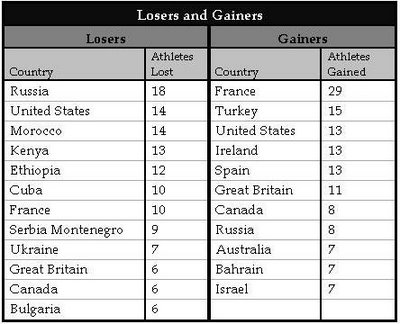
United States, Great Britain, France, Russia and Canada appear on both sides of the chart indicating ease of mobility and the transient nature of allegiance in these counties. So the net loss and gain numbers are more useful are represented in the next chart.
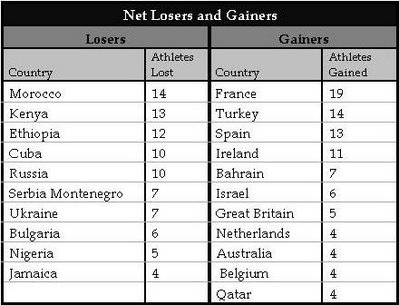
As expected, the countries with the most losses are African nations followed by former Eastern Block nations. Drilling down on Ethiopia, lets take a look at our former athletes. When, who and to where?
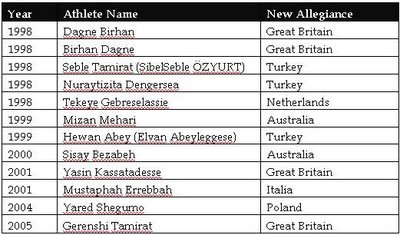
Turkey and Great Britain are the top destinations for elite Ethiopian athletes and 1998 was a pretty bad year with 5 athletes changing allegiance. In fact, if we take out 1998 we find that Ethiopia hasn’t lost more than two athletes in any given year.
The following graph has the complete trend line and a comparison of Ethiopian (red) with Kenya(gray) and Morocco(green.)

What is clear is that while we (Ethiopia) lose some athletes there is no mass exodus similar to what Ethiopia experienced in 1998 or what Kenya has recently experienced. Let's hope it stays that way.
 The story is that Mushir Salem Jawher in his greed committed a crime entering Israel by using his Kenyan passport which he should have surrendered in 2003, when he became a Bahrain citizen. After winning the Tiberias marathon in Israel, he was striped of his Bahraini citizenship, when officials of his new country where embarrassed to find out that a citizen of the Arab country had run a Marathon in Israel. I suppose there is no place like home-sweet-home because last reports on the where about of the stateless runner were that he was hiding in Kenya, afraid of arrest by Kenyan immigration officials for his passport violation. Over the last two days, the IAAF has been working to help this fellow and the IAAF has enlisted Kenyan Athletics Federation in an attempt to help him regain his Kenyan Citizenship. The final decision rests with Kenyan Immigration. You can't help but feel sorry for this dude.
I am glad to say that Ethiopia has not produced such fools. I hope this dude's ordeal serves as an example. While on this subject, I wanted to evaluate the magnitude of this trend in defections. So I went looking for numbers.
What I found was that it's almost impossible to know the number in a broad sense so to find useful numbers one must take a narrow interpretation of the term "change of allegiance". The only useful statistics that I found were kept by the IAAF which tracks when an athlete who has represented a country changes allegiance. Athletes that have never represented their country of origin such as Maryam Yusuf Jamal are not tracked by the IAAF. While the number of athletes that have competed for their country of origin and changed allegiance is limited they represent a heavy investment by the country of origin and defections are significant events. The data in the chart below is for allegiance changes since 1998. Data prior to 1998 is not available and even if it were available I am not sure it would be very useful.
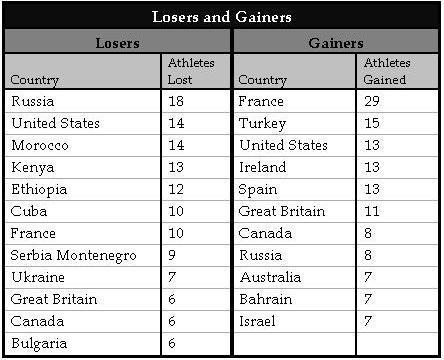
United States, Great Britain, France, Russia and Canada appear on both sides of the chart indicating ease of mobility and the transient nature of allegiance in these counties. So the net loss and gain numbers are more useful are represented in the next chart.
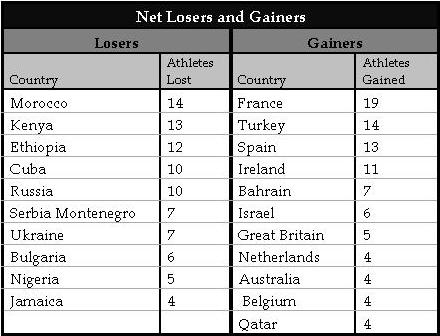
As expected, the countries with the most losses are African nations followed by former Eastern Block nations. Drilling down on Ethiopia, lets take a look at our former athletes. When, who and to where?

Turkey and Great Britain are the top destinations for elite Ethiopian athletes and 1998 was a pretty bad year with 5 athletes changing allegiance. In fact, if we take out 1998 we find that Ethiopia hasn’t lost more than two athletes in any given year.
The following graph has the complete trend line and a comparison of Ethiopian (red) with Kenya(gray) and Morocco(green.)

What is clear is that while we (Ethiopia) lose some athletes there is no mass exodus similar to what Ethiopia experienced in 1998 or what Kenya has recently experienced. Let's hope it stays that way.
Sunday, January 07, 2007
Melkam Genna
Enkuan LeBrhane Lidetu Bedehna Aderesachu- Merry Ethiopian Christmas to all. As you celebrate, make sure you do not leave out any of these steps.
Haile in the News
Haile in the news? "What's news about that?" you say, "he is always in the news." Well, this time he is not in the news for running... or organizing a race, or acting, or any of the things he has done in the past. Haile is in the news for politics! Yes, that dirty eight letter word, politics.
You think he read Roocha's earlier post on Running for Office?? Fat chance. Anyway, Haile (killer name for a politician!) apparently has been supplementing his recovery activity from Fukuoka Marathon with some under-the-radar political mediation. Some of the Ethiopian online news outlets and blogs such as Ethiopian Media Forum and Seminawork are reporting that Haile Gebrselassie and Dr. Ephraim Issac have been mediating secret talks between the Ethiopian Prime Minister and jailed opposition leaders.
Haile has been appointed a UN Ambassador in the past, but I believe this is his first direct contact with the rough and tumble "sport" of Ethiopian politics. Haile deserves admiration by his fellow citizens for being willing to risk his name and reputation in an attempt to solve the current political impasse in Ethiopia. Great job, Haile, and best wishes!
You think he read Roocha's earlier post on Running for Office?? Fat chance. Anyway, Haile (killer name for a politician!) apparently has been supplementing his recovery activity from Fukuoka Marathon with some under-the-radar political mediation. Some of the Ethiopian online news outlets and blogs such as Ethiopian Media Forum and Seminawork are reporting that Haile Gebrselassie and Dr. Ephraim Issac have been mediating secret talks between the Ethiopian Prime Minister and jailed opposition leaders.
Haile has been appointed a UN Ambassador in the past, but I believe this is his first direct contact with the rough and tumble "sport" of Ethiopian politics. Haile deserves admiration by his fellow citizens for being willing to risk his name and reputation in an attempt to solve the current political impasse in Ethiopia. Great job, Haile, and best wishes!
Tuesday, January 02, 2007
Cheers Ethiopia!
As we are getting ready to bid farewell to the year 2006 and welcome 2007 (well, that’s when this post was started), it is only fitting to add one more post to say cheers!
Happy New Year to all readers of Roocha! And a special cheers is in order for all Ethiopian Olympians. Although the past year has gone by without much mention of this, 2006 marked a milestone for Ethiopia's participation at the Olympic Games. It was 50 years ago, at the 1956 Melbourne Olympic Games, that Ethiopia made its first appearance at the Olympic Games.
There has not been much commemoration of this Golden Jubilee of Ethiopian Olympic participation. In fact, I became aware of this milestone only after hearing it mentioned several months ago by the magnificent journalist Negussie Aklilu of Voice of America’s Amharic language service. Thank you Ato Negussie and VOA Amharic for bringing this to our attention. It is a shame that we do not take time to celebrate significant historical milestones such as this. The need for celebration is highlighted in an interesting article I came across sometime ago about how Australians planned to commemorate the 1956 Melbourne Olympics- “The Friendly Games.”
By any measure, Ethiopia’s record at the Olympic Games has been outstanding. It seems that every four years Ethiopians not only win medals (which very few countries do to begin with) but also break barriers and achieve feats previously out of reach.
So, in the spirit of a new year’s tradition, let’s count down the significant accomplishment of Ethiopians at the Olympics over the past 50 years. Obviously, each entry is worthy of a separate post (note to self!) but it would not be right to let 2006 expire without making mention of these achievements, even in a hurried fashion. So, here goes:
10-Derartu Tulu wins Gold Medal at the 2000 Sydney Olympics 10000M race, eight years after her first gold medal. It is an amazing, and quite likely unmatchable, achievement to win a track race at two Olympic Games with this much time in between. This race is also notable for having Ethiopians finish 1-2 with Gete Wami claiming the Silver Medal.
9-Haile Gebrselassie wins Gold Medal at the 1996 Atlanta Olympics 10000M race. Although this was anticipated by all Ethiopians, the victory lifts the spirit of an entire nation. In advance of the Atlanta Olympics, Haile had already attracted the attention of international media by setting multiple world records on the track as well as his public relations savvy off the track. His victory in Atlanta was the deciding factor in picking Haile’s life story as the one to be featured in the movie Endurance.
8-Kennenisa Bekele wins Gold Medal at the 2004 Athens Olympics 1000M race. In the same race, Sileshi Sihine wins the Silver Medal and Haile Gebrselassie finishes fifth. But this race was more than winning medals. The team work displayed by Kennenisa and Sileshi to help out the injured Haile served as the inspiration for a popular Ethiopian music video by Tewodros Kassahun. Kennenisa and Sileshi were willing to risk their medal chances by slowing down in mid-race to allow Haile to catch up with the leaders. This was clearly the race were the “baton” was passed from one generation to the next.
7-Gezahegne Abera wins the 2000 Olympic Marathon in Sydney giving Ethiopia an unprecedented fourth Olympic Gold Medal in Men’s Marathon. Reclaiming of the Marathon Gold medal after 32 years sends Ethiopians into euphoria. In the same race, Ethiopian Tesfaye Tola wins the Bronze medal.
6-Fatuma Roba wins Ethiopia’s first Gold Medal in the Women Olympic Marathon at the 1996 Atlanta Olympics. Although Fatuma was a relatively unknown runner in 1996, she has gone on to win the next three Boston Marathons, easily distinguishing herself as one of the greatest women marathoners in the world.
5-Miruts Yifter wins two Gold Medals in the 5000M and 10000M race at the 1980 Moscow Olympics earning a rare double victory in these distances. Although Miruts had won a Bronze medal in the 5000M at the 1972 Olympics in Munich, his double victory in Moscow puts him among all time running greats. Miruts’ achievement distinguishes him as the only Ethiopian Olympian to win two Gold Medals at the same Olympics.
4-Derartu Tulu wins the 1000M at the 1992 Barcelona Olympic Games, earning the first medal by an Ethiopian woman and the first Gold Medal by a black African woman. Her victory paves the way for all the great Ethiopian woman runners that followed in her footsteps. Derartu’s success served notice that Ethiopian women runners are as much talented as the men.
3-Mamo Wolde makes it a three-peat for Ethiopia in Olympic Marathon by winning the Gold Medal at the 1968 Mexico Olympics. Mamo also won a Silver Medal in the 10000M race foreshadowing the success to come in future track races. Mamo’s victory in the marathon showed that Abebe Bikila’s victory was not just a one man show but highlighted the special talent of Ethiopian runners.
2-Abebe Bikila repeats as Olympic Marathon Champion at the 1964 Tokyo Olympics. With another Olympic Gold Medal to go with the one he won four years earlier in Rome, Abebe clearly achieves the status of a running legend that is revered to this very day. The fact that Abebe won the Tokyo race after having his appendix removed only six weeks earlier adds to the legend.
1-Abebe Bikila wins the 1960 Olympic Marathon in Rome, running barefoot, setting a new world record, and becoming the first African to win an Olympic Gold Medal. This victory would be quite significant if taken in and of itself. But from a vantage point of 45+ years in the future, it is indisputable that Abebe’s victory in Rome is single-handedly responsible for the magnitude of success African runners have achieved in the years that followed.
Happy New Year to all readers of Roocha! And a special cheers is in order for all Ethiopian Olympians. Although the past year has gone by without much mention of this, 2006 marked a milestone for Ethiopia's participation at the Olympic Games. It was 50 years ago, at the 1956 Melbourne Olympic Games, that Ethiopia made its first appearance at the Olympic Games.
There has not been much commemoration of this Golden Jubilee of Ethiopian Olympic participation. In fact, I became aware of this milestone only after hearing it mentioned several months ago by the magnificent journalist Negussie Aklilu of Voice of America’s Amharic language service. Thank you Ato Negussie and VOA Amharic for bringing this to our attention. It is a shame that we do not take time to celebrate significant historical milestones such as this. The need for celebration is highlighted in an interesting article I came across sometime ago about how Australians planned to commemorate the 1956 Melbourne Olympics- “The Friendly Games.”
By any measure, Ethiopia’s record at the Olympic Games has been outstanding. It seems that every four years Ethiopians not only win medals (which very few countries do to begin with) but also break barriers and achieve feats previously out of reach.
So, in the spirit of a new year’s tradition, let’s count down the significant accomplishment of Ethiopians at the Olympics over the past 50 years. Obviously, each entry is worthy of a separate post (note to self!) but it would not be right to let 2006 expire without making mention of these achievements, even in a hurried fashion. So, here goes:
10-Derartu Tulu wins Gold Medal at the 2000 Sydney Olympics 10000M race, eight years after her first gold medal. It is an amazing, and quite likely unmatchable, achievement to win a track race at two Olympic Games with this much time in between. This race is also notable for having Ethiopians finish 1-2 with Gete Wami claiming the Silver Medal.
9-Haile Gebrselassie wins Gold Medal at the 1996 Atlanta Olympics 10000M race. Although this was anticipated by all Ethiopians, the victory lifts the spirit of an entire nation. In advance of the Atlanta Olympics, Haile had already attracted the attention of international media by setting multiple world records on the track as well as his public relations savvy off the track. His victory in Atlanta was the deciding factor in picking Haile’s life story as the one to be featured in the movie Endurance.
8-Kennenisa Bekele wins Gold Medal at the 2004 Athens Olympics 1000M race. In the same race, Sileshi Sihine wins the Silver Medal and Haile Gebrselassie finishes fifth. But this race was more than winning medals. The team work displayed by Kennenisa and Sileshi to help out the injured Haile served as the inspiration for a popular Ethiopian music video by Tewodros Kassahun. Kennenisa and Sileshi were willing to risk their medal chances by slowing down in mid-race to allow Haile to catch up with the leaders. This was clearly the race were the “baton” was passed from one generation to the next.
7-Gezahegne Abera wins the 2000 Olympic Marathon in Sydney giving Ethiopia an unprecedented fourth Olympic Gold Medal in Men’s Marathon. Reclaiming of the Marathon Gold medal after 32 years sends Ethiopians into euphoria. In the same race, Ethiopian Tesfaye Tola wins the Bronze medal.
6-Fatuma Roba wins Ethiopia’s first Gold Medal in the Women Olympic Marathon at the 1996 Atlanta Olympics. Although Fatuma was a relatively unknown runner in 1996, she has gone on to win the next three Boston Marathons, easily distinguishing herself as one of the greatest women marathoners in the world.
5-Miruts Yifter wins two Gold Medals in the 5000M and 10000M race at the 1980 Moscow Olympics earning a rare double victory in these distances. Although Miruts had won a Bronze medal in the 5000M at the 1972 Olympics in Munich, his double victory in Moscow puts him among all time running greats. Miruts’ achievement distinguishes him as the only Ethiopian Olympian to win two Gold Medals at the same Olympics.
4-Derartu Tulu wins the 1000M at the 1992 Barcelona Olympic Games, earning the first medal by an Ethiopian woman and the first Gold Medal by a black African woman. Her victory paves the way for all the great Ethiopian woman runners that followed in her footsteps. Derartu’s success served notice that Ethiopian women runners are as much talented as the men.
3-Mamo Wolde makes it a three-peat for Ethiopia in Olympic Marathon by winning the Gold Medal at the 1968 Mexico Olympics. Mamo also won a Silver Medal in the 10000M race foreshadowing the success to come in future track races. Mamo’s victory in the marathon showed that Abebe Bikila’s victory was not just a one man show but highlighted the special talent of Ethiopian runners.
2-Abebe Bikila repeats as Olympic Marathon Champion at the 1964 Tokyo Olympics. With another Olympic Gold Medal to go with the one he won four years earlier in Rome, Abebe clearly achieves the status of a running legend that is revered to this very day. The fact that Abebe won the Tokyo race after having his appendix removed only six weeks earlier adds to the legend.
1-Abebe Bikila wins the 1960 Olympic Marathon in Rome, running barefoot, setting a new world record, and becoming the first African to win an Olympic Gold Medal. This victory would be quite significant if taken in and of itself. But from a vantage point of 45+ years in the future, it is indisputable that Abebe’s victory in Rome is single-handedly responsible for the magnitude of success African runners have achieved in the years that followed.
Tuesday, December 26, 2006
2006 Top 9
9 Coming off Berlin victory, Haile Gebrselassie wins Fukuoka International Marathon
 3-Dec-06 Disproving doubters. Proving Berlin was not a fluke. Haile showed that he can beat anyone by defeating two-time World Marathon champion Jaouad Gharib of Morocco. 2006 is the year we witnessed Haile became a complete marathoner.
 8 Meseret Defar Retains 3,000 Meters World Indoor Title
 11-Mar-06 In Moscow, Meseret Defar defended here 2004 World Indoor 3000 M title easily defeating World record holder and home favorite Liliya Shobukhova. It seems like the sky is the limit for Meseret Defar.


7 Kenenisa Wins World Indoor Title at 3000 M
 12-Mar-06 Kenenisa became the first athlete win a World Outdoor Championships, a World Cross Championships and a World Indoor Championship. He toyed with the field wining over 3000 M at the World Indoor Championships.
6 Meseret Defar Beats Tirunesh Dibaba at the Final Golden League Meet, ISTAF Berlin
 10-Sep-06 Once again Meseret Defar wins a race. Only this time it’s controversial because Tirunesh Dibaba’s loss cost Tirunesh $125,000. We now have ourselves a rivalry. May the best woman win.
 5 Meseret Defar breaks the 5,000m road race world record
10-Apr-06 Going where no woman has gone Meseret Defar demolishes the 5K road record shared by Paula Radcliffe and Tirunesh Dibaba by five seconds. This lady has had a spectacular year.4 Meseret Defar sets the Womens 5000 M world record
 3-Jun-06 Meseret Defar sets a new Womens 5000 M world record 14:24.53, snatching the record from Turkey’s ex-Ethiopian runner Elvan Abeylegesse's. It was a 0.15 second improvement. Nonetheless, this one was sweet.
 3 Berhane Adere Wins Chiago Marathon, Sets Ethiopian Record
 22-Oct-06 The way Berhane Adere disposed of Galina Bogomolova in the Chicago marathon made us wonder if she should have been marathoning all along. She sure looked like a natural setting a new Ethiopian record of 2:20.47.
2 Haile Gebrselassie & Gete Wami of Ethiopia Win 2006 Berlin Marathon (Both Set Ethiopian Records)
 26-Sep-06 Haile Gebrselassie and Gete Wami set Ethiopian records while winning this Marathon Majors event. This was a reminder that they have not faded yet. Gete ran 2:21:24 and this record was later broken by Berhane Adere.
 1 Kenenisa Bekele- Double Win at World Cross Country Championships
 2-Apr-06 Running two races in two days in, 2002,2003,2004,2005 and now 2006 Kenenisa Bekele wins the long and short race at the World Cross Country Championship. Kenenisa has won ten titles during the last five years and single handedly brought an end to the era of Kenyan cross country dominance. No one will ever dominate this event like Kenenisa Bekele has.


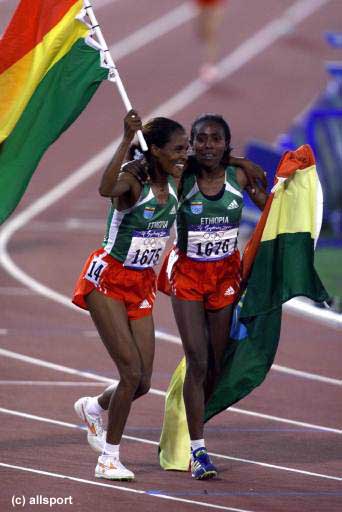


Monday, December 25, 2006
Merry Christmas!
Today in the town of David a Savior has been born to you;
he is Christ the Lord.
(Luke 2:11)
For to us a child is born,
to us a son is given,
and the government will be on his shoulders.
And he will be called
Wonderful Counselor, Mighty God,
Everlasting Father, Prince of Peace.
(Isaiah 9:6)
he is Christ the Lord.
(Luke 2:11)
For to us a child is born,
to us a son is given,
and the government will be on his shoulders.
And he will be called
Wonderful Counselor, Mighty God,
Everlasting Father, Prince of Peace.
(Isaiah 9:6)
Subscribe to:
Posts (Atom)